|

Lab
Diagnostic Testing: Adenovirus
The laboratory
diagnosis of ocular adenovirus infection is a function of the onset
of clinical symptoms. The earlier the conjunctival samples are collected
after clinical onset, the higher likelihood of a positive result.
The adenoviral load of viable virus and antigen decreases over time.
Four tests can be used for laboratory diagnosis: 1) cell
culture, 2) shell
vial, 3)
EIA (Adenoclone), and 4) PCR.
All clinical
ocular samples suspected of possible adenoviral infection are tested
with Adenoclone
for rapid detection, shell vial for three day detection, and cell
culture to confirm negative Adenoclone and negative shell vial results.
We are also testing with PCR to determine whether adenoviral DNA
is present in the chronic conjunctivitis patient and whether non-culturable
adenovirus is present in some cases. We also feel that PCR may possibly
be more diagnostic in specimens collected at the late onset of infection.
Specimen
Collection
Cell
Culture
Shell
Vial Culture
EIA
(Adenoclone)
PCR
Specimen
Collection
Specimens are directly collected by vigorously swiping the exposed
conjunctiva with a plastic soft-tipped applicator. Cornea samples
are not necessary. Topical anesthetic can be applied to the conjunctiva
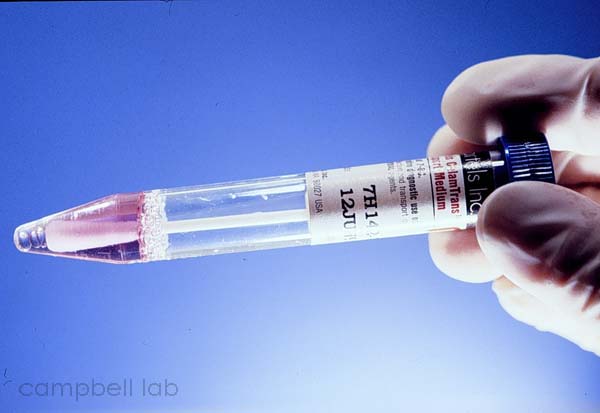
but this is optional. Collected samples are placed in 2.0 ml of
viral transport medium. We have had great success with Bartels Chlamydial
transport medium and recommend its use. Viral culturettes can also
be used for transportation to the laboratory and these can be transferred
to the viral medium. All laboratory testing can be processed from
the 2.0 ml of chlamydial transport medium. Adenovirus is not a fastidious
virus. It will remain viable under many conditions and collected
samples should be easily transported through mail carriers.

Cell
culture
The "gold" standard for adenovirus laboratory testing
is cell culture. Collected samples are layered on a monolayer of
cells in test tubes. If present, adenovirus will present as cytopathic
effect of rounded cells. The cytopathic effect of adenovirus is
confirmed for the presence of antigen by EIA (Adenoclone). The best
cell-line for testing adenovirus is A549. These are a human carcinoma
continuous cell-line. When samples are collected within one to three
days of clinical onset, cell culture generally is positive within
four to seven days. Samples collected after three days may take
one to three weeks to produce cytopathic effect. Cell culture will
confirm an adenovirus diagnosis but it may not provide timely results
for immediate patient care. All virology laboratories can offer
cell culture isolation for adenovirus.

CPE observed in cell culture (A549 cells).

Shell
Vial Culture
Shell vial is another cell culture test but the results are ready
in three days. Vials of A549 cells are inoculated with collected
samples and centrifuged. The vials are then incubated and stained
at day three with immunofluorescent antibodies specific to adenovirus.
The cells infected with adenovirus will light up with examination
under a fluorescent microscope. We found that shell vial highly
correlates with standard cell culture especially when samples are
collected within seven days of clinical onset. Shell vial testing
is processed by many virology laboratories especially those involved
with respiratory virus. We highly recommend shell vial testing for
diagnosing ocular adenovirus infection.
Positive stained cells in Adenovirus shell vial
culture.

EIA
(Adenoclone)
Adenoclone is an enzyme immunoassay that can detect adenoviral antigen
from collected ocular specimens. Positive results can be obtained
within 75 minutes. Unfortunately, Adenoclone is only 40 to 50 percent
sensitive in detecting adenoviral antigen from clinical specimens.
A high load of antigen is necessary for a positive test and this
correlates with collection within one to three days of clinical
onset. The power of this test is that it does provide rapid results
when tests are positive but negative tests need to be confirmed
with cell culture or shell vial. Adenoclone is not widely offered
by diagnostic laboratories.
Positive Adenoclone test.

PCR
Polymerase Chain Reaction (PCR) is a molecular test that amplifies
specific adenoviral DNA sequences from clinical samples and then
identifies the amplified products with gel techniques. PCR is a
highly sensitive and specific test that can detect adenoviral DNA
from clinical samples. Results can now be obtained within one to
three days. PCR technology is always evolving and testing within
30 minutes will soon be a reality. PCR testing can be quite expensive
to the self-pay patient. Make sure the patient has insurance coverage.
Many molecular laboratories may not offer adenoviral PCR testing
but this may soon be changing.

Gel electrophoresis image of Adenovirus PCR product.

|